 dYdX swap
 fees: Maker and Taker Costs for Your First Trade
dYdX swap fees depend on the selected trading product, executed trade value, and applicable fee schedule. For perpetual trades, multiply each fill's value by its maker or taker rate, then total the charges. A limit order can take liquidity, so selecting a limit price alone does not establish maker treatment. Spot swaps have separate cost inputs. Before submitting your first order, confirm the relevant account rate and available funds; afterward, compare the estimate with completed fills and the resulting account state.
For perpetual trades, maker or taker treatment depends on how each fill executes, while its quantity and price establish the value used to calculate the fee.
Maker and Taker Costs for the Same Trade
A useful fee comparison holds the market, direction, and executed value constant. Under those conditions, the difference between maker and taker charges comes from their applicable rates. A maker fill supplies resting liquidity; a taker fill consumes an existing order. The account's fee schedule determines the charge for each role.
Execution price remains a separate part of that comparison. Waiting for a maker fill can change when, whether, and at what price the trade completes. An immediately executable order prioritizes available liquidity, subject to its execution restrictions. Comparing a maker estimate for one quantity with a taker estimate for another obscures both the fee difference and the difference in exposure.
Available Collateral Before Fee Estimates
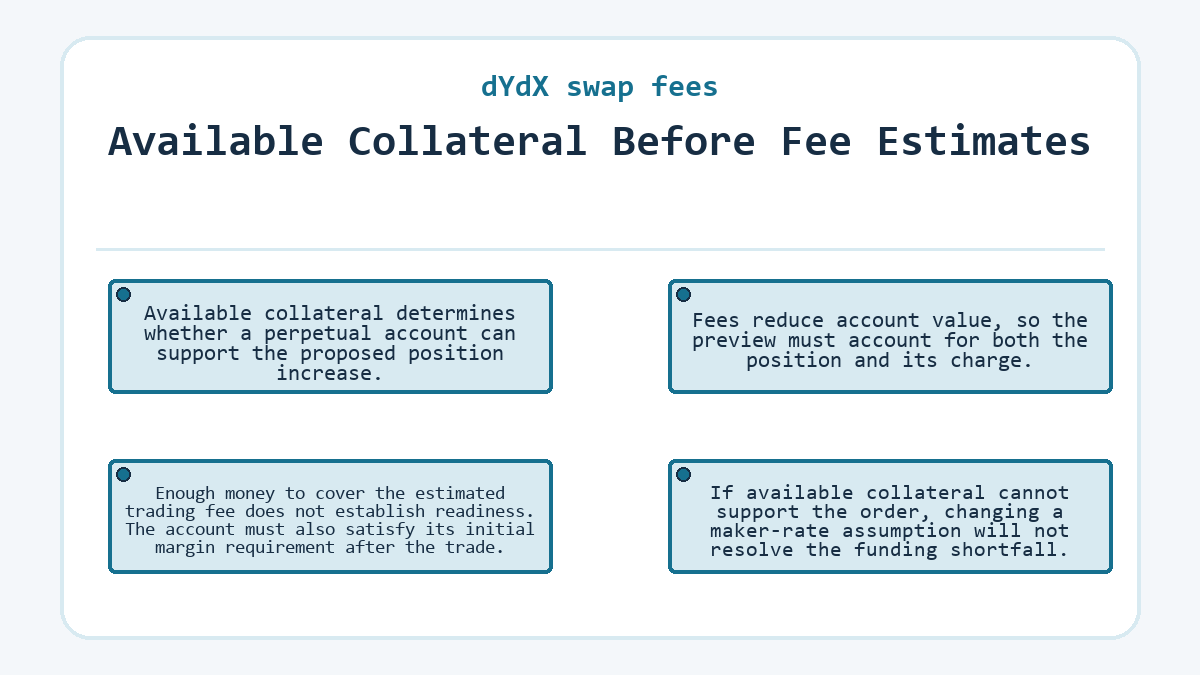
Available collateral determines whether a perpetual account can support the proposed position increase. Enough money to cover the estimated trading fee does not establish readiness. The account must also satisfy its initial margin requirement after the trade. Fees reduce account value, so the preview must account for both the position and its charge. If available collateral cannot support the order, changing a maker-rate assumption will not resolve the funding shortfall.
Execution Settings and Fee Eligibility
Execution choices govern how an order reaches a fill and which fee treatment can apply. Some choices below combine a limit price with an execution policy. They describe different controls, rather than mutually exclusive product categories. Spot swaps use a separate execution path, so perpetual maker eligibility does not establish their charges.
| Execution Choice | Fee Treatment | Required Execution Condition |
|---|---|---|
| Perpetual market order | Taker treatment on completed matches | Matching liquidity within the order's execution bounds |
| Marketable perpetual limit order | Taker treatment on immediately crossing fills | Opposite orders at the limit price or better |
| Resting perpetual limit order | Maker treatment when another order takes it | A resting order and a later matching counterparty |
| Post-only perpetual limit order | Maker treatment if it fills | The order must enter without immediately matching |
| Immediate-or-cancel perpetual limit order | Taker treatment on its executed portion | Immediate liquidity at an acceptable price |
| Spot swap | Applicable swap, venue, and network charges | Supported input funds and an executable swap |
A limit price restricts acceptable execution prices. Post-only adds a separate restriction on immediate matching, while immediate-or-cancel prevents an unfilled remainder from resting.
Post-Only Protection and the Cost of Waiting
Post-only makes maker eligibility an execution condition. If an order would immediately match existing liquidity, the policy prevents its placement instead of allowing a taker fill. A lower maker estimate therefore requires an order capable of resting when it reaches the book.
A post-only cancellation leaves that particular order without an executed trade fee. It also leaves the intended trade incomplete. Retrying at a price capable of resting preserves the maker condition, but provides no promise of execution. Removing post-only changes the permitted behavior and requires a fresh taker-cost estimate.
Waiting has an economic consequence even without a charged fee: the intended exposure may remain absent while prices move.
Fill Value as the Calculation Base
Executed notional is the value of the quantity actually traded at its execution price. It supplies the calculation base for a percentage trading fee. Margin is the collateral supporting the position, so using the deposit amount can understate the charge.
For a fill with quantity q, execution price p, and a decimal fee rate r, the calculation is q × p × r. Use quantity and price units that produce the settlement value. The quantity represents the magnitude traded, regardless of whether the order buys or sells.
For several fills, calculate each charge using that fill's price, quantity, and applicable rate. Add the results afterward. Multiplying the full submitted quantity by a preview price assumes complete execution at that price, which the final records may not support.
Leverage does not add another multiplier after you have calculated executed notional. If you begin with collateral rather than trade value, you have started from a different quantity. Keep those inputs separate, and preserve calculation precision until comparing the result with the recorded charge.
Account Rates and Volume Tiers
The account's applicable fee tier supplies the maker and taker rates for the calculation. dYdX's perpetual fee structure uses each user's trailing 30-day trading volume across their subaccounts and markets. Governance can change the schedule, so a saved rate table may cease to match an execution.
The account fee display provides the relevant starting inputs before submission. Preserve both rates and any applicable discount conditions with the estimate. A maker rebate appears as a negative fee where the schedule permits it. That credit differs from a separate promotional reward paid under its own eligibility conditions.
Quoted Prices and Execution Costs
A trade preview combines an estimated execution price with an estimated fee. Those inputs answer different questions. The fee rate determines the explicit charge; available liquidity determines the prices the order can reach. A change in either input can move the estimated total.
Slippage describes the difference between a comparison price and actual execution. The bid-ask spread describes the gap between available buying and selling prices. Neither necessarily appears as a separate fee debit. When comparing total execution costs, avoid counting the same price difference twice by adding a spread estimate to slippage already measured against the same reference price.
Recorded Fees Across Partial Fills
Fill records connect the completed quantity with the execution price and charged fee. An order total alone may hide differences between fills. A partial execution also leaves less traded value than the original estimate assumed, even when its average execution price stays close to the preview.
Under dYdX's default perpetual fee rules, trading fees apply to executed fills at the applicable rate. A canceled remainder contributes no further executed value. Any charge for the completed portion remains part of the trade's cost.
Reconciliation needs the actual maker or taker treatment for the completed trades. A limit order can cross immediately and leave a remainder resting, so its fills need not all share the same role. Apply each relevant rate to its corresponding value rather than assigning one rate from the order's label.
The resulting position and account balance provide a separate consistency check. Position size should reflect executed buys and sells. Account value can also move with prices, funding, and transfers, so its total change alone cannot identify a fee error. Identify which input or record explains the mismatch before placing another trade in response.
Spot Swap Charges and Output Amounts
Spot swaps require their own cost breakdown because their output is a token balance. Perpetual maker and taker rates do not establish the cost of this separate execution path. The quoted input, expected output, and applicable charges define the spot comparison.
dYdX's December 2025 Solana spot launch waived its interface fee for that month while retaining applicable liquidity-pool, launchpad, and network fees. Check the current quote for the interface fee rather than assuming the launch waiver still applies. A displayed interface fee also cannot establish the total swap cost by itself.
Compare the confirmed token movement with the quoted output using the same units. Charges already embedded in the quoted output should not enter the total again as additional deductions.
Funding and Transfer Costs
Funding changes the economics of holding a perpetual after execution. Payments depend on the position and funding rate, and the account can pay or receive them. They belong separately from the maker or taker charge associated with opening or changing the position.
Moving funds into or out of a trading account can introduce transfer costs. dYdX Chain's default trading flow does not charge traders a separate gas fee for each perpetual trade. That property does not establish free deposits, withdrawals, or spot transactions. A first-session budget should distinguish account funding costs from execution costs, especially when the transfer happens only once while several trades follow.
Entry Fees and Closing Costs
A completed entry establishes its own fee, not the entire cost of a position's lifetime. Closing through another trade produces additional executed value and an applicable charge. Its price and maker or taker treatment can differ from the entry, even when the closing quantity matches.
Before submitting an order, its size and execution restrictions remain editable. After a fill, an opposite trade creates another transaction rather than refunding the first charge. Canceling an unfilled remainder can stop further execution once effective, but it cannot undo completed fills. If the first trade's fee remains unexplained, preserve its records and resolve the calculation before committing more funds.
dYdX swap fees questions, answered
Do I Need to Stake DYDX Before My First Perpetual Trade?
Staking DYDX is not a general prerequisite for perpetual trading. It can qualify an account for fee discounts under the applicable staking and trading tiers. Only eligible bonded stake counts toward those discounts; tokens undergoing unbonding do not. Staking discounts apply to positive trading fees and do not increase a negative maker rebate.
How Do I Convert Basis Points Into a Trading Fee?
One basis point equals 0.01%, or 0.0001 as a decimal multiplier. Multiply executed trade value by the quoted number of basis points divided by 10,000. A rate already expressed as a percentage needs division by 100 instead. Mixing percentage and basis-point notation creates a large calculation error even when the trade value is correct.
Does Splitting My First Order Into Smaller Orders Reduce Its Percentage Fee?
Splitting an order does not inherently reduce a percentage fee. If the combined executed value and applicable rate remain identical, the combined charge remains equivalent before rounding effects. Separate orders can encounter different prices, liquidity, or maker and taker treatment, so any actual difference must come from those changed inputs.
Why Can a Losing Closing Trade Still Carry a Fee?
A closing trade incurs its applicable execution fee regardless of whether the position made a profit. The calculation uses executed value and fee treatment, rather than the position's investment return. Realized trading losses and execution charges therefore remain separate components of the account result.
Is Increasing Trading Volume Solely to Reach a Lower Fee Tier cost-effective?
A lower future rate does not automatically offset the cost of generating additional trading volume. Extra trades bring their own fees and exposure to execution prices. The relevant comparison is the cost of that added activity against savings on trades already intended, while accounting for the schedule's trailing-volume conditions.
When Should a Promotional Rebate Enter My first-trade Cost Calculation?
A promotional rebate belongs in a separate conditional estimate until eligibility and payment are established. The original execution fee remains the charge to reconcile against the fill. A later reward may use another asset or payment schedule, so its advertised value does not necessarily equal an immediate reduction in the trade's settlement cost.